
Education
Only 23% of refugee adolescent girls are enrolled in secondary school, compared to 84% of adolescents worldwide, and refugee girls are only half as likely as boys to reach a classroom at all. (Source: UNHCR, "Her Turn" report, 2025) In displacement, that gap compounds: lost years of schooling become lost access to safety, stability, and a livelihood.
Education is a pathway to new opportunities, empowerment, and economic stability. It is also a fundamental human right. Most of the refugee girls we serve have had their schooling interrupted and therefore been excluded from the benefits of education.
“School means routine, normality, purpose, and time away from the pressures and burdens of refugee life…especially so for girls, who are vulnerable to exploitation and to sexual and gender-based violence.” – United Nations High Commissioner for Refugees (UNHCR)
RefuSHE exists to close that gap. Our holistic approach to education is rooted in the Girls Empowerment Program (GEP), a comprehensive education program that prepares refugee girls and young women with the skills they need to rebuild their lives and upstart their entrepreneurial futures. We focus on strengthening academic and economic achievement by providing refugee girls with school scholarships, life skills workshops, leadership development, vocational training, ICT classes, onsite childcare, daily meals, and access to a wide variety of livelihood opportunities.
Access to Primary & Secondary Education
According to UNHCR’s 2025 Refugee Education Report, gross primary enrolment among refugees stands at just 67% — well below the rate in low-income countries generally (102%) and in fragile or conflict-affected countries (94%). At the secondary level, refugee enrolment falls further still, to 37%. Overall, nearly half of all school-aged refugee children — 46% — remain out of school entirely. (Source: UNHCR, 2025 Refugee Education Report, “The Unbreakable Promise: Resilience and Resolve in Refugee Education”)
Driven by government changes to Kenya’s adult education curriculum and feedback from GEP participants, RefuSHE transitioned to a new model of basic education provision in 2024. Rather than offer accelerated primary education courses on RefuSHE’s campus, we help refugee girls access primary and secondary education within the Kenyan public school system by providing scholarships that cover the cost of their school fees, supplies, meals, and transportation. Integrated with their Kenyan peers, refugee students take classes in functional numeracy, English and Swahili literacy, creative arts and sports, social sciences, and STEM (Science, Technology, Engineering, and Mathematics) according to the new Kenya Department of Education curriculum.
98%
OF GEP STUDENTS WHO SIT FOR THE CBC/CBE EXAM, RECEIVE THEIR CERTIFICATE OF PRIMARY EDUCATION
Life Skills Development
Northeastern Kenya — home to the majority of the country’s refugee population — has the country’s highest recorded rates of both female genital mutilation and child marriage. (Source: University of Nairobi, Journal of Human Rights, 2025) Without knowledge of their rights, refugee girls are left with fewer tools to protect themselves against these risks.
We provide GEP students with training on sexual and reproductive health, human rights, conflict resolution, leadership, community collaboration, and gender-based violence prevention and response so that they may develop a confident voice in the decisions that affect their lives. By learning about their rights and how to claim them, refugee girls become resilient, self-assured, and empowered leaders.
78%
OF GEP STUDENTS EXPRESS HIGH LEVELS OF CONFIDENCE IN THEMSELVES, THEIR EDUCATION, AND THEIR ECONOMIC FUTURES
Vocational Training

Refugees in Kenya face significantly higher unemployment than the host population — in one national survey, 60% of refugees were unemployed compared to 16% of non-refugees. (Source: UNHCR / World Bank, “How Kenya Can Create Shared Prosperity by Addressing Constraints to Refugee Self-Reliance,” 2021)
Our goal is to equip refugee girls with the technical and practical skills they need to become financially independent once they leave our programs. We offer vocational training tracks in dressmaking and fabric colouration, digital literacy, cosmetology, and more. We also provide access to income-generating opportunities through the Artisan Collective and partnerships with organizations that facilitate entrepreneurship training and job placements. RefuSHE ensure our students feel empowered and prepared to enter the job market and successfully build careers upon completion of their training.
Digital Learning & Livelihoods
Across Sub-Saharan Africa, 230 million women remain unconnected to mobile internet — the widest gender gap in digital access of any region in the world. (Source: GSMA, Mobile Gender Gap Report 2026)
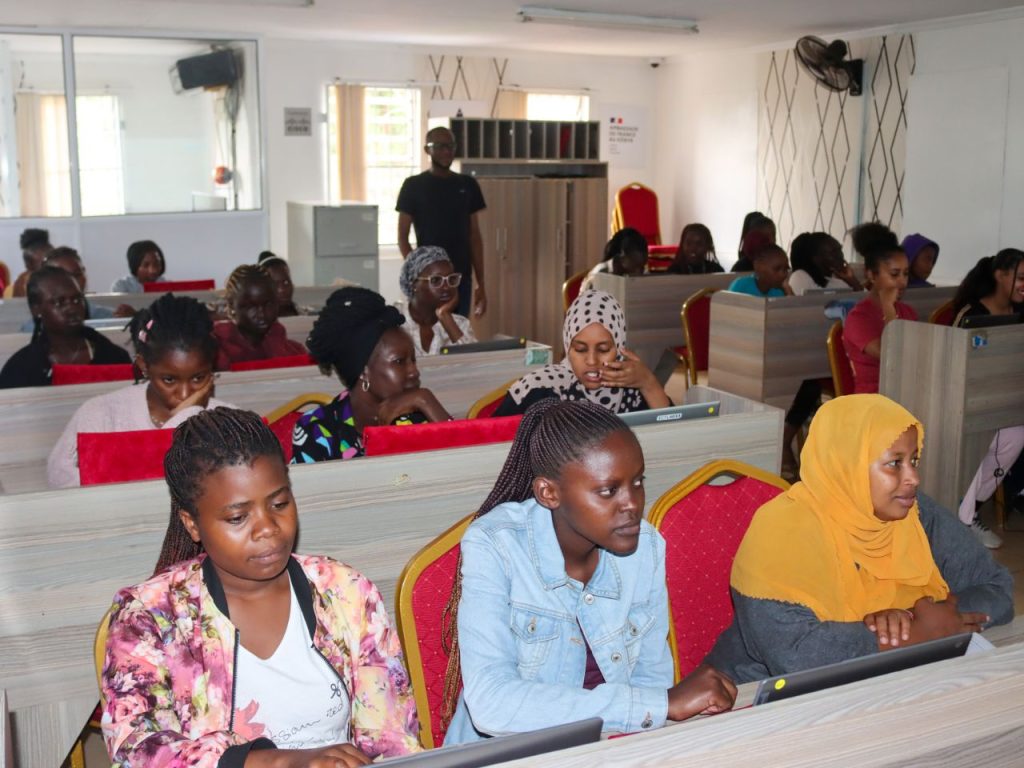
RefuSHE is on a mission to ensure that young, urban refugee women are no longer relegated to the margins of society and pushed into economic activities and situations that rob them of their safety, dignity, and power. We boost their socio-economic potential by providing gender-responsive digital skills training in digital literacy, Microsoft Office, graphic design, digital marketing, artificial intelligence, data management, and online freelancing to access job opportunities in the growing freelance economy. Our on-campus ICT Lab is a hub for both GEP students and local young women looking to enter the digital marketplace and increase their earning potential from anywhere in the world.
Early Childhood Development Center
Across Sub-Saharan Africa, more than six million pregnant and parenting girls between the ages of 10 and 19 are out of school — dropping out not by choice, but for lack of childcare, financial support, or a school willing to have them back. (Source: UNESCO, “Supporting the Education and Health of Young Mothers in Africa,” 2024)
Nearly a third of the girls on our campus have at least one child, often as a result of forced pregnancy. Without proper childcare, it can become near impossible for refugee girls and young women to pursue their education. RefuSHE’s on-campus Early Childhood Development Center (ECDC) offers a safe space for over 60 infants and toddlers of young mothers in our programs. The presence of this full-service daycare program allows mothers to attend their education courses on site while also attending to their children throughout the day.
84%
OF CHILDREN IN THE DAYCARE DEMONSTRATE AGE-APPROPRIATE PROGRESS IN PHYSICAL, BEHAVIORAL, AND COGNITIVE DEVELOPMENT